
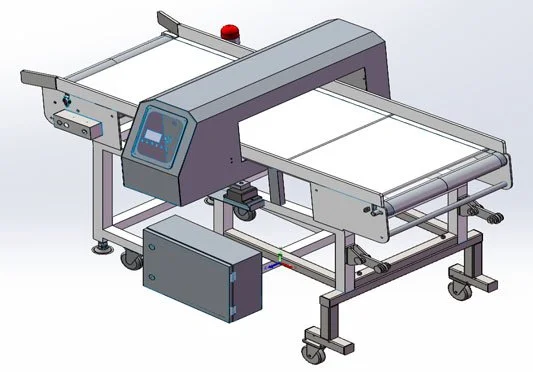
Metal Detector
To detect and automatically reject metal contaminants (ferrous, non-ferrous, stainless steel) within food products during production or packaging to ensure consumer safety and comply with strict global food safety regulations (HACCP, GFSI, FDA, USDA, EU).
Model:TT-MD6020
Accuracy:Fe≥1.0mm,Non-
Fed≥1.5mm,SUS≥2.0mm
Rejection:Alarm Stop(Forzen Meat Block 25Kg)
Belt Width(mm):600
Belt Speed(m/min):25
Size(mm):1800*600*900~1050
Weight(kg):650
Material:Fram SS304
Power:110v/60Hz
Why Specialized for Food?
Product Effect: Wet, salty, or high-moisture foods (meat, cheese, bread) conduct electricity, interfering with detection. Food-grade detectors compensate for this "product signal."
Hygiene: Constructed with food-safe materials (stainless steel, specific plastics) and designs for easy cleaning (IP69K rating common).
Environment: Resists water, dust, steam, temperature fluctuations, and corrosive washdown chemicals.
Integration: Designed to fit seamlessly into high-speed production lines (conveyors, pipelines, gravity systems).
Key Components
Aperture / Detection Head:
The "tunnel" through which product passes.
Contains transmit and receive coils generating the balanced electromagnetic field.
Made of robust, non-metallic, food-grade materials (e.g., FDA-approved polyurethane, fiberglass).
Often modular for different product sizes.
Reject System:
Critical Component: Automatically removes contaminated product upon detection. Types:
Pusher Arm: Knocks product off the conveyor.
Air Blast: Uses compressed air jets.
Diverter Flap/Conveyor: Diverts product to a reject bin.
Retracting Belt: Stops/drops the contaminated section.
Must be fast, reliable, and hygienic.
Control Unit:
Houses the sophisticated electronics and processor.
Features:
Touchscreen HMI (Human-Machine Interface).
Sensitivity adjustment & product learning/setup.
Automatic product compensation (handles product effect).
Reject verification sensors.
Data logging (event records, OEE tracking).
Password protection & audit trails.
Connectivity (Ethernet, PLC I/O).
Conveyor System (Integrated or Standalone):
Food-grade belt, often detectable (metal-free) or designed not to trigger the system.
Speed synchronized with detection and rejection.
Sensitivity Test Kits:
Includes test wands/spheres of known sizes (Fe, Non-Fe, SS) for regular verification.
Detection Principle (Advanced)
Balanced Coil System: Creates a "null" zone in the aperture.
Product Passage: As food passes through, its inherent conductivity/magnetism ("product effect") slightly unbalances the field. The detector learns and compensates for this baseline signal during setup.
Contaminant Detection: Metal contaminants cause a significantly larger and distinct disturbance than the product itself.
Signal Processing: Sophisticated algorithms analyze the signal's phase and amplitude to:
Distinguish metal from the product effect.
Identify the metal type (ferrous, non-ferrous, magnetic/non-magnetic stainless steel).
Pinpoint its location within the product stream.
Rejection: Triggers the reject mechanism precisely when the contaminant reaches the reject point.
Types for Food Applications
Conveyor Systems: Most common. For packaged goods (boxes, bags, trays) or bulk products on belts.
Pipeline Systems (Free-Falling):
For pumped liquids, slurries, powders, granules (sauces, soups, milk, flour, grains).
Product flows vertically through a non-metallic pipe surrounded by the detector head.
Rejection typically via diverter valve.
Pipeline Systems (Under Pressure):
For viscous products or those needing hygienic closed systems.
Detector head clamps around a section of existing metal pipe (requires special calibration).
Gravity Systems: For free-falling bulk products or individual items (e.g., apples, potatoes, frozen veggies).
Pharmaceutical & Chemical Variants: Similar principles, often with stricter material requirements.
Critical Performance Factors
Sensitivity: Measured by the smallest detectable metal sphere (Fe, Non-Fe, SS) at the center of the aperture. Affected by:
Aperture size (smaller = better sensitivity).
Product effect (worse in wet/salty products).
Metal type (SS 316 is hardest; ferrous easiest).
Packaging (foil packaging requires specialized systems).
Stability: Consistent performance despite environmental changes (temperature, vibration, line speed).
Reject Reliability: Must remove contaminated product every time without false rejects.
Ease of Cleaning & Validation: Sanitary design is paramount. Must be easy to verify performance (test pieces).