
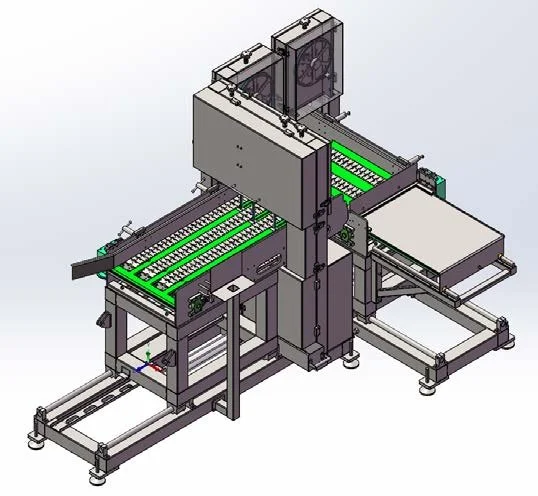
Frozen Meat Cutter
To safely, efficiently, and precisely cut large frozen meat blocks (typically -10°C to -30°C / 14°F to -22°F) into smaller portions, slices, cubes, strips, or flakes for further processing (grinding, cooking, packaging) in frozen or semi-frozen state.
Model:QKJ01A-00
Size(mm):2260×1140×1830+2320×1440×1680
Weight(kg):1700
Max. Cut Size(mm):600*600*150
Number of divided blocks:12
Conveyor Speed:300mm/s
Saw Speed:29m/s
Capacity:3000 kg/h
Air Pressure:6 bar
Power:110v/60Hz2
Supply:480V/60Hz/5*1.5KW+2*0.55KW
Why Specialized for Frozen Meat?
Extreme Hardness: Requires immense cutting force and specialized blades.
Consistency Demands: Must produce uniform pieces despite ice crystal variability.
Temperature Sensitivity: Blades/machinery must withstand thermal shock and prevent thawing.
Safety Critical: Handling rock-hard blocks with high-force blades demands rigorous safeguards.
Hygiene: Must withstand harsh washdowns and prevent bacterial harborage.
Key Components
Heavy-Duty Frame: Robust stainless steel (SS304/SS316) construction to handle vibration, impact, and corrosion.
Cutting Head:
Blades: Tungsten carbide-tipped (TCT), diamond-coated, or specialized hardened steel. Designed for ice-crystal abrasion resistance.
Blade Configuration: Guillotine, band saw, circular saw, reciprocating blades, or oscillating blades (for flaking).
Drive System: High-torque electric motor (often >15-30 HP) with gearbox/reducer to deliver necessary force.
Feed System:
Hydraulic Pusher Plate: Applies immense, controlled force (up to tons) to advance the frozen block into the blade(s).
Conveyor Belt/Chain: For continuous feed systems (e.g., flakers, slicers).
Automatic Loader: (Advanced systems) Robotic arms or lift tables to position heavy blocks.
Cutting Chamber: Enclosed, insulated area containing the blade(s) and feed path. Often lined with UHMW plastic or food-grade composites to reduce friction and noise.
Control System:
PLC (Programmable Logic Controller) with HMI Touchscreen.
Adjusts cut thickness, feed rate, blade speed, cycle times.
Safety interlocks and diagnostics.
Product Handling:
Discharge Conveyor: Moves cut pieces away.
Collection Bins/Chutes: For flakes or small pieces.
Safety Systems:
Emergency Stops: Multiple accessible points.
Light Curtains/Safety Mats: Stops machine if breached.
Blade Guards/Interlocks: Prevents access during operation.
Two-Hand Controls: For initiation cycles.
Cooling System (Optional): Liquid CO₂ or nitrogen jets to maintain sub-zero temps in the cutting zone.
Common Cutting Methods & Machine Types
Guillotine (Vertical) Cutters:
Action: A massive single blade drops vertically through the block.
Output: Large slabs or "steaks."
Use: Primary breakdown of large blocks (e.g., 60-lb beef blocks) into portions for further processing.
Band Saws:
Action: Continuous loop blade moving at high speed.
Output: Slabs, strips, or irregular cuts.
Use: Versatile cutting; common in smaller processors/butcheries. Requires careful sanitation.
Circular Saws:
Action: Large diameter rotating blades (single or multi-blade).
Output: Precise slices, cubes (with cross-cut capability).
Use: High-speed slicing for portion control (e.g., bacon, steaks).
Reciprocating Saws:
Action: Blades move back-and-forth horizontally.
Output: Slices or strips.
Use: Efficient slicing of thinner blocks.
Flakers / Grinders:
Action: Oscillating blades or rotating drums with cutting teeth shave the frozen block.
Output: Flakes, shreds, or coarse grind.
Use: Pizza toppings, taco fillings, sausage production, pet food. Produces thawed-ready meat.
Cubers / Dicers:
Action: Multi-blade grids (cross-cut) slice blocks into uniform cubes.
Output: Precise cubes (e.g., stew meat, kebabs).
Use: High-value portioning.
Critical Operational Considerations
Meat Block Specs: Size, shape, temperature, fat/lean ratio, and bone content significantly impact performance.
Cutting Force: Ranges from 5 tons for poultry to 50+ tons for large frozen beef blocks.
Throughput: Industrial machines process hundreds of kg/lbs to several tons per hour.
Blade Maintenance: Frequent sharpening/replacement is essential. Automated sharpening systems exist.
Temperature Control: Cutting generates heat; managing this prevents thawing and quality loss.
Hygiene & Sanitation: IP69K rating, clean-in-place (CIP) capabilities, and sanitary design are mandatory. Band saws require extra vigilance.
Noise & Vibration: Significant challenges requiring dampening and operator protection (PPE).
Applications in Food Industry
Pre-Grind Sizing: Cutting blocks for frozen meat grinders.
Portioned Products: Steaks, chops, stew meat, stir-fry strips.
Ingredient Prep: Cubes for soups, dices for ready meals, flakes for pizza/toppings.
Further Processing: Supplying sized pieces for cooking, marinating, or forming.
Pet Food Production: Flaking or cubing frozen meat/by-products.
Advantages vs. Cutting Fresh Meat
Extended Shelf Life: Meat remains preserved until final processing.
Improved Yield: Minimal drip loss; cleaner cuts with frozen fat.
Safer Microbiology: Pathogens are dormant.
Easier Automation: Rigid blocks handle predictably.
Year-Round Supply: Enables use of meat frozen during peak seasons.
Selection Factors for Plants
Primary Output: Slabs, slices, flakes, cubes?
Input Block Size/Weight: Max dimensions & weight capacity?
Required Throughput (kg/hr or lbs/hr)?
Meat Type(s): Beef, pork, poultry? Bone-in?
Cut Precision/Tolerance: Need for exact portion control?
Integration: Feed from freezer? Discharge to grinder/conveyor?
Automation Level: Manual block loading vs. robotic?
Sanitation Standards: Required certifications (EHEDG, 3-A)?
Footprint & Utilities: Space, power (3-phase), compressed air?
Safety Compliance: Region-specific standards (OSHA, EU Machinery Directive)?